
The books are two months behind. Receipts sit in a shared folder, the bank feed has hundreds of uncategorized lines, and you have not seen a clean profit and loss report since spring. Meanwhile, you are the one answering customer calls, managing the team, and chasing payments.
That is usually the moment owners start searching for bookkeeping outsourcing services. The real question is not whether to outsource. It is when, and what a fair arrangement costs. This guide covers both.
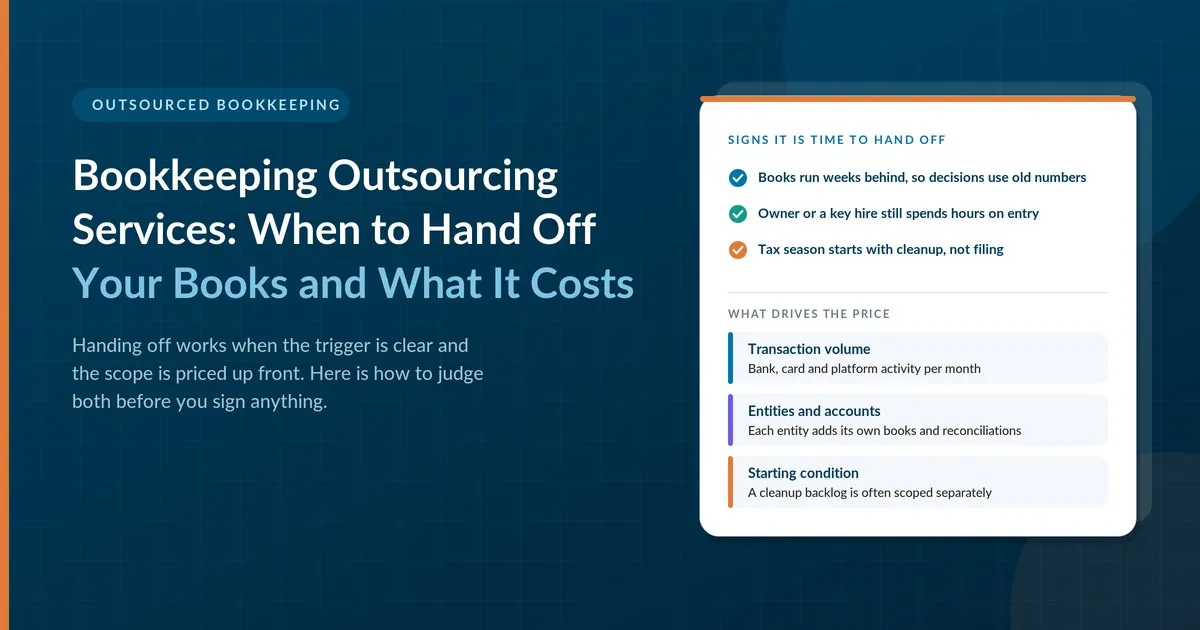
Signs It Is Time to Hand Off Your Books
Most owners wait too long. They treat bookkeeping as a chore they can catch up on later, and “later” turns into a tax-season scramble.
Look for these signals:
- Reconciliations run more than 30 days behind.
- You cannot say what last month’s profit was without opening a spreadsheet.
- Your tax preparer keeps asking for missing documents.
- You spend more than a few hours a week on data entry.
- You have added a location, a sales channel, or employees, and the old system no longer fits.
- A lender or investor has asked for financials you cannot produce quickly.
Two or three of these is a clear signal. One alone may only mean you need a better routine.
What Outsourced Bookkeeping Actually Covers
Scope matters more than price, so define it first. A solid package usually includes:
- Transaction coding. Bank and card activity is categorized to the right accounts.
- Monthly reconciliation. Every account matches its statement, so errors surface early.
- Accounts payable and receivable. Bills are tracked and paid on time, and unpaid invoices are flagged.
- Month-end close. The books are locked, reviewed, and reported by a set date.
- Financial reports. You receive a profit and loss report, balance sheet, and cash summary each month.
- Support for your tax preparer. Clean records flow to your accountant at year-end.
Providers of outsourced bookkeeping services often add payroll processing, sales tax tracking, and cleanup of older records. Ask which of these are included and which cost extra.
What Drives the Cost
Price follows complexity. Two businesses with the same revenue can need very different levels of work.
| Cost driver | Why it moves the price |
|---|---|
| Transaction volume | More transactions mean more coding and review time |
| Number of accounts | Each bank, card, and processor needs its own reconciliation |
| Backlog | Catching up on months of unfinished books is a separate project |
| Industry needs | Inventory, job costing, or multi-state sales tax adds work |
| Payroll | Running payroll or reconciling it adds a recurring task |
| Number of entities | Each company needs its own books and reports |
| Reporting level | Basic reports cost less than management-level reporting |
A business with 150 transactions a month and one bank account is a very different job from one with 1,500 transactions across five accounts and two sales channels. Treat any quote that ignores these factors with caution.
Three Common Pricing Models
Providers generally use one of three approaches. Each has trade-offs.
Flat monthly fee. You pay a set amount for a defined scope. This is the easiest to budget. The risk is a scope that is too narrow, with extras billed on top.
Hourly billing. You pay for time spent. This suits small or irregular work. The risk is an unpredictable bill, especially if the books are messy.
Tiered by volume. The fee rises with transaction count or revenue. This scales fairly as you grow, but you should check where each tier ends.
For most small businesses, a flat fee with a clearly written scope is the cleanest option. Ask what happens if your volume doubles, and ask how backlog work is priced.
The In-House Comparison Most Owners Skip
Owners often compare an outsourced fee to a bookkeeper’s salary alone. That comparison leaves out most of the real cost.
Suppose you hire a part-time or full-time bookkeeper at $50,000 a year. Employer payroll taxes add 7.65% for Social Security and Medicare, which is $3,825. Your cost is now $53,825, before paid time off, benefits, software licenses, training, and the time you spend managing the work.
Then consider coverage. One person cannot cover vacations, sick days, or a resignation. When that person leaves, your books stall and someone has to rebuild the process.
If you are also weighing accounting support beyond bookkeeping, this explainer on what outsourced accounting is shows where the two services overlap.
An outsourced team spreads those risks across several people. You trade daily desk access for steady output and backup coverage. For many businesses under about 20 employees, that trade is worth it. A larger company with heavy daily transaction flow may still prefer someone in-house.
What a Good Handoff Looks Like
A rushed start is the biggest reason outsourcing disappoints. A well-run handoff follows a clear path.
Days 1 to 15: Access and review. You grant read access to bank feeds and your accounting software. The provider reviews your chart of accounts and open items.
Days 15 to 45: Cleanup. Past months are reconciled and corrected. This is where unusual items, such as duplicate entries or personal expenses, get sorted out.
Days 45 to 90: Steady rhythm. The provider delivers monthly reports on an agreed date. You review the first few closes together and adjust the scope.
If a provider cannot describe their onboarding in this kind of detail, expect a messy start.
Keep Control While You Hand Off the Work
Outsourcing the work does not mean giving up oversight. A few habits protect you:
- Keep ownership of your bank and software accounts. The provider gets user access, not the master login.
- Approve bill payments yourself, or set a clear approval limit.
- Review each monthly report, even briefly, and ask about anything unusual.
- Make sure the provider keeps clean support for every entry. The IRS explains what to keep in its recordkeeping guidance for small businesses.
- Ask where your data is stored and who can view it.
Questions to Ask Before You Sign
Use these on your first call. Specific answers point to real experience.
- Which software do you work in, and who owns the file?
- What exactly is included in the monthly fee?
- How is cleanup work priced?
- What date will I receive my reports each month?
- Who is my main contact, and who covers when they are out?
- How do you handle a missing receipt or an unclear transaction?
- How do I end the agreement, and how do I get my files back?
The last question matters more than most owners expect. A good provider makes it easy to leave, and that confidence is itself a good sign.
A Simple Way to Decide
- List the hours you or your team spend on bookkeeping each month.
- Add the cost of errors, late filings, and delayed decisions.
- Compare that to written quotes from two or three providers with the same scope.
- Run a 90-day trial with clear deliverables.
- Review the results. If you can now answer “What was my profit last month?” within minutes, the arrangement works.
Final Thought
Good bookkeeping gives you one thing above all: decisions made with current numbers. Outsourcing makes sense when the work is falling behind, when your business has outgrown a single person, or when your time is better spent elsewhere. Choose a provider on scope, process, and reporting rhythm first, and price second. The cheapest quote with the narrowest scope rarely turns out to be the least expensive option.
This article is for general information only and is not tax or legal advice. Consult a qualified professional about your situation.
About the author: Ameet Lohana is a bookkeeping and accounting systems specialist at Datastub, an outsourced accounting and bookkeeping firm serving U.S. contractors, ecommerce sellers, and growing small businesses. Crunch. Strategize. Deliver.